The Nashville Number System Explained for Songwriters
Nashville session musicians have been reading charts in numbers since the 1950s. The reason is simple: when a producer calls a session and says "we're cutting this in F#," nobody wants to rewrite their chord chart from scratch. If you wrote the chart in numbers, you just note the key at the top and play. The numbers handle the rest.
The Nashville Number System uses the integers 1 through 7 to represent each chord in a key by its scale degree position. It is the same logic as Roman numeral analysis — just written with Arabic numerals and a few extra conventions that make it faster to scribble on a session chart.
The basics
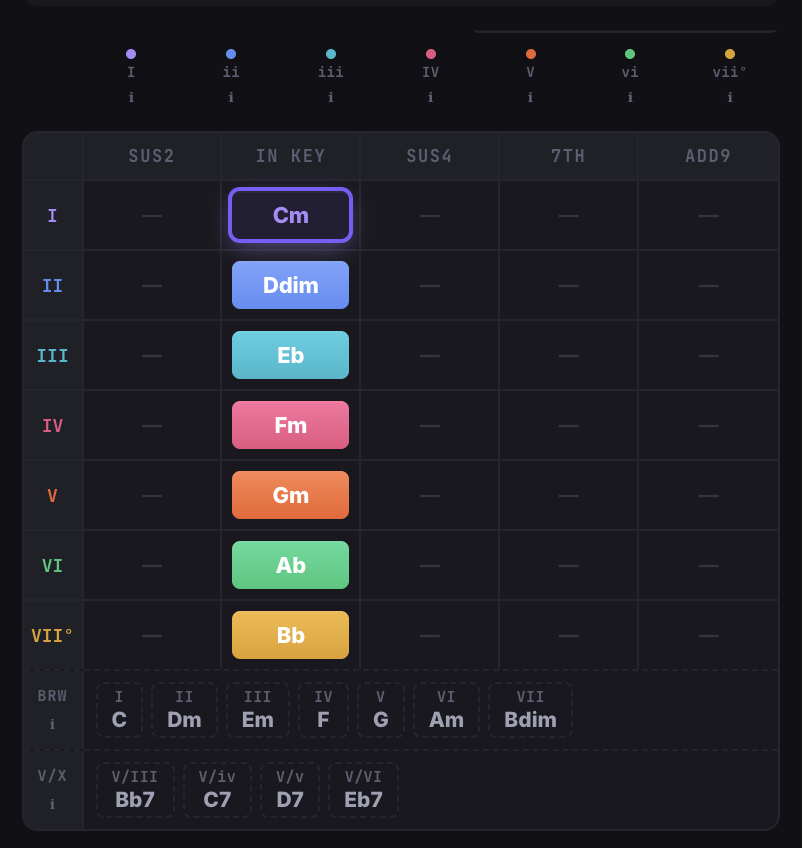
The number 1 is always the tonic chord — home base. The number 4 is always the subdominant. The number 5 is always the dominant. This is true regardless of what key you are in.
In C major: 1 = C, 2 = Dm, 3 = Em, 4 = F, 5 = G, 6 = Am, 7 = Bdim.
In G major: 1 = G, 2 = Am, 3 = Bm, 4 = C, 5 = D, 6 = Em, 7 = F#dim.
In Eb major: 1 = Eb, 2 = Fm, 3 = Gm, 4 = Ab, 5 = Bb, 6 = Cm, 7 = Ddim.
The chart does not change. The key at the top tells every player which notes to land on. A guitarist playing in their comfortable G-shape-with-capo can read the same chart as the keyboard player who would rather be in C. The numbers are the common language between them.
This is what makes the system so durable. It was developed by pianist Charlie McCoy and adopted by the Nashville session community precisely because it removed key-change friction from fast-paced studio work. It has been in use ever since.
Major vs. minor chords
In a major key, not all seven chords are major. The diatonic pattern gives you three major chords (built on degrees 1, 4, and 5), three minor chords (built on degrees 2, 3, and 6), and one diminished chord (built on degree 7).
Nashville notation handles this in a compact way:
- Major chords are plain numbers: 1, 4, 5.
- Minor chords get a minus sign after the number: 2-, 3-, 6-.
- Diminished chords get a degree symbol: 7°.
Some older charts or players use lowercase numbers for minor (2, 3, 6), but the minus-sign convention is the most common standard in contemporary studio work. Either version communicates the same information — you just want everyone in the room reading the same convention.
A chord that is not diatonic gets annotated differently. A sharp in front of the number raises it a half step; a flat lowers it. So a bVII (the flat-seventh major chord, a common borrowed chord in rock and pop) gets written as b7. A secondary dominant — a V-of-something — gets written as 5/4 or similar. The system is informal enough to accommodate real-world notation habits.
A full chart example
Here is a simple song written in Nashville notation:
Key: C

Verse:  1 - 6- - 4 - 5
Chorus: 4 - 1 - 5 - 1
Bridge: 6- - 4 - b7 - 5
That is the complete chord chart. To play it in C: verse uses C, Am, F, G. Chorus uses F, C, G, C. Bridge uses Am, F, Bb, G.
Now change the key to G without rewriting a single number:
Key: G

Verse:  1 - 6- - 4 - 5
Chorus: 4 - 1 - 5 - 1
Bridge: 6- - 4 - b7 - 5
Verse is now G, Em, C, D. Chorus is C, G, D, G. Bridge is Em, C, F, D.
The chart is identical. The key at the top is all you changed. That is the whole point.
Why LandChords is built on this
If you only need to move a chart between keys, the free chord transposer does the arithmetic for you. Inside a song, LandChords stores every chord by its Roman-numeral degree rather than by its letter name. This is the same system — just using Roman numerals instead of Arabic ones, with the same underlying logic. When you build a chord progression in the Chord Maker → Try it and then change the key field, every chord shifts to its correct name in the new key without any manual editing.
The color-coded degree view in the editor is a visual Nashville chart. Each degree has a consistent color across every song, so after a little time in the app, you start to recognize visual patterns — you will see a "one-four-five chorus" at a glance the same way a session player reads it numerically.
When you Transpose → Try it in LandChords, you are doing exactly what Nashville musicians do when they move the key reference at the top of the chart. The underlying degree relationships are untouched; only the key shifts.
Using it when co-writing or playing with a band
Once you internalize number-based thinking, it changes how you talk about music with other people. Instead of saying "let's go to the F chord," you say "go to the four." A guitar player in G and a piano player in C and a singer thinking in A can all follow "go to the four" without confusion.
"One four five" is a complete description of a chord sequence. "Verse is one, four, five; chorus is four, one, five, one" communicates a full song structure in eleven words, regardless of anyone's preferred key.
This is why Nashville session work is so fast. Musicians do not waste time recalculating chord names for every key change. They internalize the functional relationships between degrees, and the numbers are just a notation for those relationships.
The practical advice: start using numbers in your own notes even if you are not working with other musicians. Write "verse: 1–4–5, chorus: 4–1–5" instead of writing out chord names. After a few weeks, you will find yourself hearing harmonic movement in terms of function rather than letter names — and writing progressions becomes faster as a result.
If you want to dig deeper into the underlying theory, music theory for songwriters covers scale degrees, harmonic function, and borrowed chords from the ground up. The Nashville Number System is the practical notation layer on top of that theory — you can use it effectively even before you fully understand all the theory underneath it.