Music Theory for Songwriters (Only the Parts You Actually Need)
Music theory gets a reputation for being dry and difficult. A lot of that reputation comes from the way it is taught — as a comprehensive system you have to master before you can use any of it. For songwriting, that is backwards. You do not need to understand everything. You need about five concepts, applied immediately, and then your ear takes over and does the rest of the work.
Here are the parts that actually matter.
The major scale
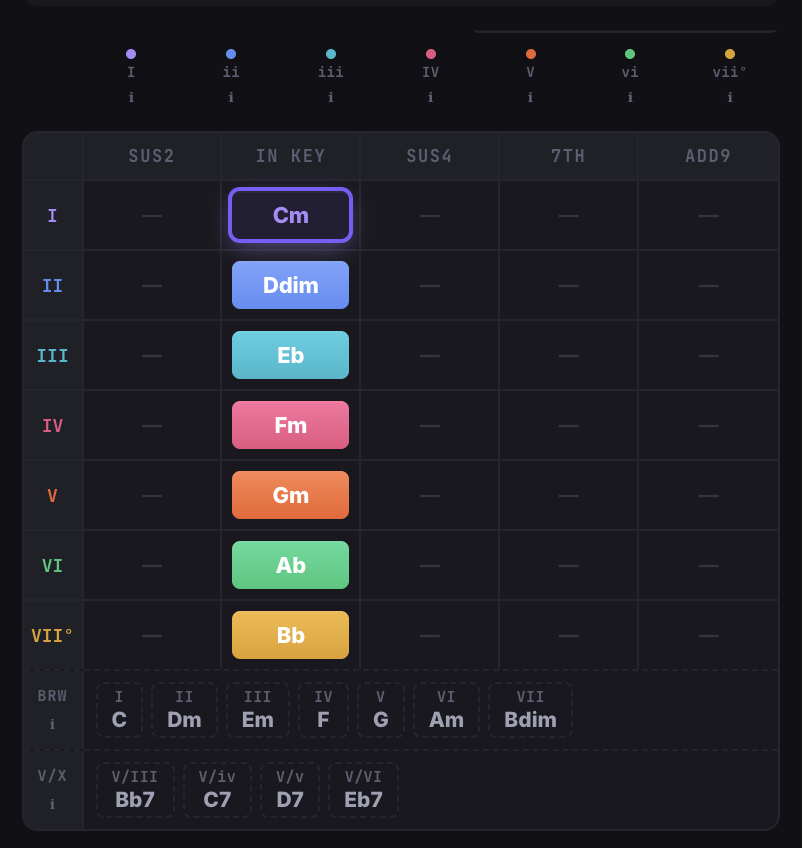
The major scale is seven notes arranged in a specific pattern of whole steps and half steps from a root note. In C major those notes are C, D, E, F, G, A, B. In G major they are G, A, B, C, D, E, F#. Every major key follows the same interval pattern from a different starting point.
You do not need to memorize the interval pattern (W-W-H-W-W-W-H if you want it), and you do not need to work it out by hand either: a free scale finder will show you the notes and chords of any key instantly. What you need to know is this: the key you choose determines which notes and chords are "in key." Everything you build musically in that key comes from those seven notes. The key is not a constraint — it is the framework that makes your harmonic choices coherent.
The minor scale follows a different interval pattern, but for now the most useful thing to know is that every major key has a closely related minor key that shares the same notes. More on that below.
Diatonic chords
When you stack notes from the major scale to build chords, you get seven chords — one built on each scale degree. These are called diatonic chords, meaning they are built entirely from within the key.
In any major key, the pattern is always the same:
- Degree 1 (I): major
- Degree 2 (ii): minor
- Degree 3 (iii): minor
- Degree 4 (IV): major
- Degree 5 (V): major
- Degree 6 (vi): minor
- Degree 7 (vii°): diminished
Three major, three minor, one diminished. This is your default chord palette for any key. You can write an enormous number of songs using only these seven chords.
In C major that is: C, Dm, Em, F, G, Am, Bdim. In G major: G, Am, Bm, C, D, Em, F#dim.
The Roman numerals describe the relationship, not the specific chord name. This is why writing in degrees is more useful than memorizing chord names — the relationships transfer across every key.
The three harmonic functions
This is the concept that unlocks the most about why certain progressions feel satisfying and others feel unresolved.
Every diatonic chord has a functional role — not just a position, but a job it does in the harmonic motion of the song:
Tonic function (home): The I chord is the primary home. The vi chord also has a tonic-adjacent feeling — it shares two notes with the I chord and provides an emotional alternative to straight resolution. Tonic function feels stable and resolved.
Subdominant function (movement away from home): The IV chord creates movement away from home without creating tension. It feels open, unresolved but not urgent. The ii chord has the same function. This is why I–IV sounds like something starting to move.
Dominant function (tension before resolution): The V chord creates pull back to home. Your ear hears it as unresolved and wants it to resolve to I. The vii° chord has the same tension quality. This is the most important functional relationship in Western harmony: V wants to go to I.
Once you understand function, chord progressions make sense structurally. A verse often moves between tonic and subdominant — it creates mild movement without strong resolution. A chorus often hits the dominant before returning to tonic — that V-to-I arrival is what makes the chorus feel conclusive and satisfying.
The relative minor
Every major key has a relative minor. The relative minor shares the exact same seven notes and the exact same seven diatonic chords — it just treats a different chord as home.
The relative minor is always built on the sixth scale degree of the major key. In C major, that is A minor (the vi chord). In G major, it is E minor. In Bb major, it is G minor.
C major and A minor share: C, D, E, F, G, A, B. Their seven diatonic chords are identical. The difference is which chord functions as the tonic. In C major, C feels like home. In A minor, A feels like home.
This is why songs can pivot between a major key and its relative minor without sounding like they left the key. The chords are the same; only the emotional center shifts. Starting a progression on the vi chord rather than the I chord is the simplest way to shift from a bright, resolved feeling to something more wistful or restless — without adding a single new chord.
Borrowed chords
Diatonic chords are your default palette, but you can borrow chords from outside the key and they can work beautifully. The trick is knowing which borrowed chords blend in and which sound jarring.
The two most useful borrowed chords for songwriters:
The bVII chord: This is the major chord built one whole step below your tonic. In C major, that is Bb major. It does not exist in the C major scale — Bb is a note from C minor. But in practice it sounds natural and adds rock or folk color to a major-key song. The bVII is one of the most common chords in pop, rock, and country, and it rarely feels out of place.
The iv minor chord: In a major key, the IV chord is major. The iv minor is borrowed from the parallel minor (same root, different scale). In C major, that means Fm instead of F. It introduces the minor third and creates a darker emotional contrast. I–IV–iv–I uses this move to great effect — the shift from major IV to minor iv has a bittersweet quality that major-only progressions cannot achieve.
One borrowed chord per section is usually enough. Two or three and the key center starts to feel unstable.
What you don't need
For songwriting, you can safely ignore counterpoint, figured bass, species counterpoint, 12-tone technique, and most modal theory beyond a basic awareness that Dorian (a minor mode with a raised 6th) sounds more hopeful than natural minor, and Phrygian (a minor mode with a lowered 2nd) sounds darker and more unsettling.
You do not need to know how to resolve a dominant seventh in four-voice chorale style. You do not need to understand Neapolitan chords or augmented sixths. You do not need to read staff notation if you have not learned it — Roman numerals and the Nashville Number System are sufficient for functional harmony.
What songwriting theory is actually about: understanding what creates harmonic tension and what releases it. The five concepts above — scale, diatonic chords, harmonic function, relative minor, and borrowed chords — cover the vast majority of what happens in pop, rock, country, folk, and R&B harmony.
Learn those five things, apply them in actual songs, and your ear will start to fill in the gaps automatically. Theory is useful only when it accelerates what you are already hearing. If a concept does not help you write or understand something you want to write, it can wait.
The best next step is to open the Chord Maker → Try it and build a progression using only diatonic chords. Try I–IV–V, then I–vi–IV–V, then substitute one borrowed chord and listen to the difference. The theory clicks much faster when you can hear it change in real time.