How to Write a Chord Progression (A Practical Guide)
A chord progression is just a sequence of chords played in a key. The good news: a handful of patterns power most of the songs you already love. Learn to think in scale degrees instead of fixed chord names and you can write a progression in any key, then move it to another in seconds.
Start with the key, not the chords
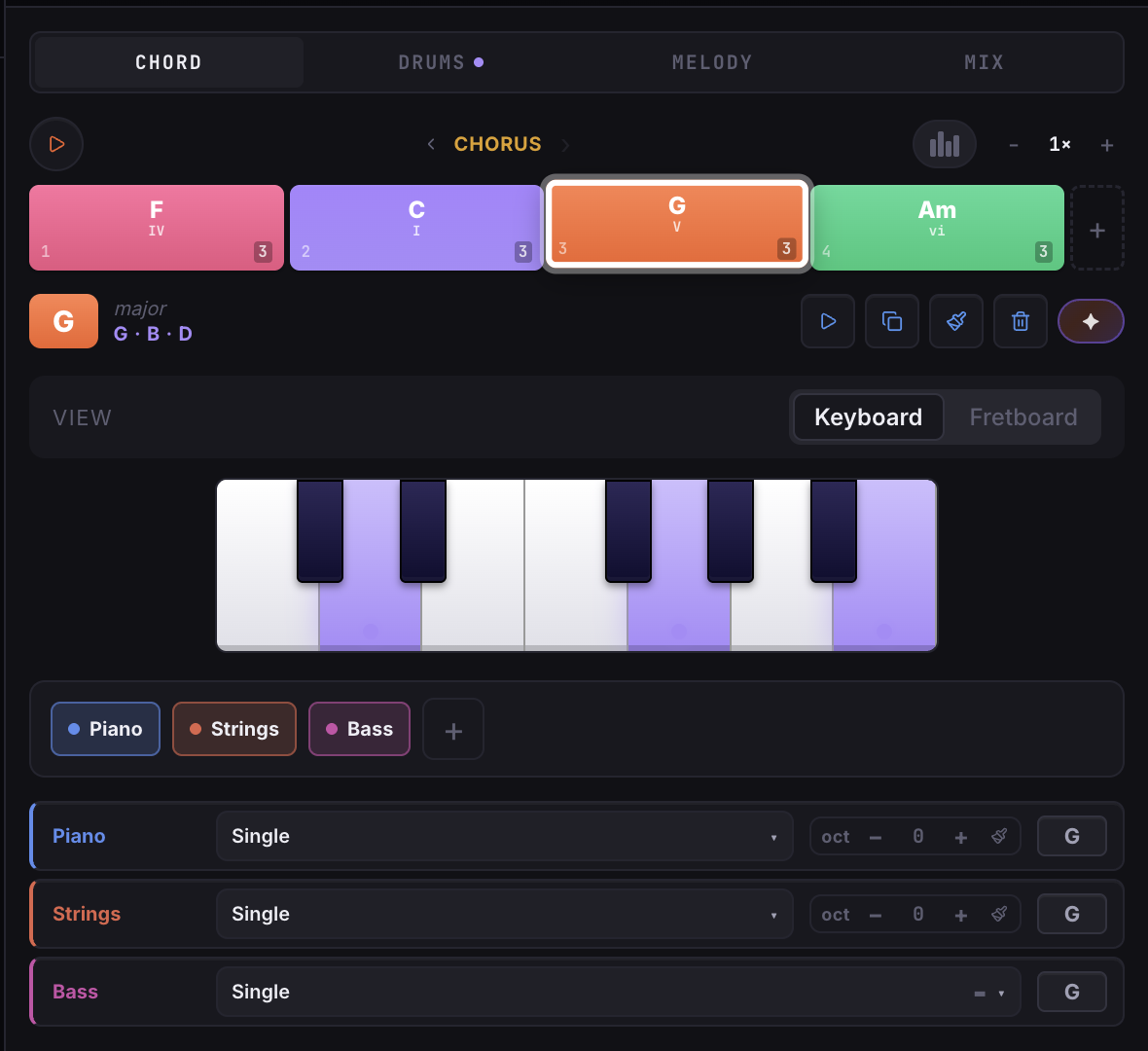
Pick a key first (say, C major). Every key gives you seven diatonic chords, which we number with Roman numerals:
- I, IV, V: the major chords (in C: C, F, G)
- ii, iii, vi: the minor chords (in C: Dm, Em, Am)
- vii°: the diminished chord (in C: B°)
Thinking in numbers is the single biggest unlock. The progression I–V–vi–IV is the same emotional shape whether you play it in C, G, or E. Only the letters change. That's exactly how the Chord Maker → Try it stores your chords, so transposing is one click.
Four progressions that always work
- I–V–vi–IV: the "four-chord song." Bright, anthemic, everywhere.
- vi–IV–I–V: the same four chords starting on the minor, more wistful.
- I–vi–IV–V: the classic 50s doo-wop turnaround.
- ii–V–I: the backbone of jazz and a satisfying way to resolve home.
Try each one out loud. Your ear already knows these. Naming them just lets you reach for them on purpose.
Give chords a job
Progressions feel like motion because chords pull toward each other:
- I is home: stable and resolved.
- V creates tension that wants to fall back to I.
- IV is a gentle step away from home.
- vi is the emotional, minor-tinted cousin of I.
A progression is just a little journey away from home and back. Lengthen the trip for tension, resolve to I when you want the listener to exhale.
Add motion without new chords
Before you reach for fancier harmony, get more out of what you have:
- Change the rhythm. Hold I for two bars, then move quickly through IV–V.
- Invert a chord so the bass note walks stepwise instead of jumping.
- Borrow one chord from outside the key for a single moment of colour, then return.
Then write to it
The fastest way to learn is to loop a progression and sing over it. In LandChords you can loop a section, Lyric Lab → Try it, and Vocal Studio → Try it the moment a melody shows up, all in the same tab.
Stuck on the next chord? Ask for AI chord suggestions in your key and genre. Every plan includes a few a day, and Pro raises the daily limit.
Quick checklist
- Pick a key and think in numbers (I, IV, V, vi).
- Start from a proven pattern like I–V–vi–IV.
- Use V to build tension and I to resolve.
- Add motion with rhythm and inversions before adding chords.
- Loop it and sing. Keep what makes you want to keep singing.
Want to try the ideas above without signing up? The free chord progression generator runs in the browser. When you are ready to turn a loop into a whole song, start free and build your first progression in a couple of minutes.
Try it in LandChords
Pick a key, add chords by scale degree, and hear them play back.
Switch key above to transpose ↑