Guitar Chord Progressions Every Songwriter Should Know
Guitar is the most common songwriting instrument, and for good reason. The open strings ring sympathetically with the most-used chords, the instrument is portable, and a capo makes key changes trivially easy without learning new shapes. But the real advantage of understanding guitar chord progressions is that the best ones work in any key — because they're built on intervals, not specific note names.
The progressions below are explained in Roman numerals. That notation means the same sequence of relationships applies whether you're playing in G, D, E, or A — just move the capo or barre the root differently. The fingering pattern stays the same; the pitch changes.
Open-position favorites
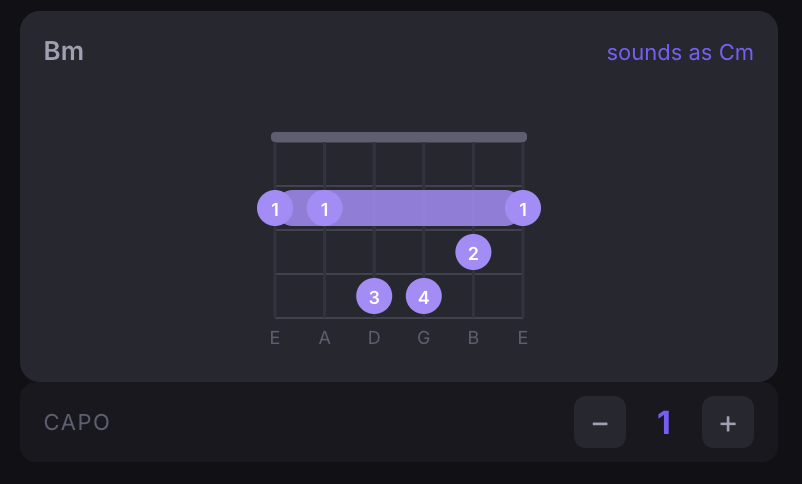
Open-position chords have at least one or two open strings ringing, which gives them a full, resonant quality that barre chords don't quite match. The following three progressions cover the most useful harmonic movements in the most guitar-friendly keys.
G–Em–C–D — I–vi–IV–V in G major
This is the natural habitat of the acoustic guitar. All four chords are comfortable, open-position shapes. The I–vi–IV–V movement is complete — tonic, relative minor, subdominant, dominant — and the resolution from D back to G is strong without being abrupt. The progression loops cleanly and sits well under a wide range of melodic approaches. Countless folk, country, and singer-songwriter recordings live right here.
C–Am–F–G — I–vi–IV–V in C major
The same Roman numeral structure as the G progression, one step higher. C major is slightly less guitar-friendly than G because F requires a partial or full barre, but the payoff is access to a slightly warmer, less twangy register. This is the key that works well for a mid-range male or female voice without a capo.
D–A–Bm–G — I–V–vi–IV in D major
The axis progression in D, starting on V instead of I. The Bm is a barre chord or can be played as a partial barre, making this slightly more demanding than pure G-major open position. But D is one of the guitar's most resonant keys — the open D and A strings ring through the I and V chords and give the whole progression a bright, spacious sound.
Using a capo to change key
The capo is the guitar player's transposition tool. Place it at any fret and it raises the pitch of all six strings by one semitone per fret — but you use the same chord shapes and the same Roman numerals as if you were playing open.
This is what makes the capo powerful for songwriting: you can write a progression as G–Em–C–D (I–vi–IV–V in G shapes) and then capo up to find the key that fits your voice, without changing a single finger position.
- Capo 2 + G shapes = A major
- Capo 4 + G shapes = B major
- Capo 5 + G shapes = C major
- Capo 5 + C shapes = F major
- Capo 7 + C shapes = G major
The Roman numerals stay constant. The key changes. This is why understanding progressions by number rather than by chord name is so much more practical for guitarists — the moment you put on a capo, the letter names change but the relationships don't.
For a deeper look at transposition logic, Transpose → Try it covers how LandChords applies the same principle to any song in the chord builder.
Barre chord progressions
Barre chords sacrifice the sympathetic ring of open strings for portability and consistency. Any barre-chord shape can slide up or down the neck, which means one shape gives you twelve chord options.
Am–F–C–G — vi–IV–I–V in C major (played as barre chords)
This is one of the most common rock and alternative progressions. Starting on the Am barre at the fifth fret (or the open Am shape followed by F barre) gives the progression a heavier, more driven sound than the open-position version. The I–V–vi–IV rotation (starting the same chords on vi) is the same harmonic content as the pop axis progression — just in a different emotional register because of the starting chord and the barre voicing.
Electric guitar players default to this. The fuller, more compressed sound of barre chords on electric fits rock and R&B better than the ringy, string-heavy sound of open-position playing.
Two-chord loops
Many iconic songs use only two chords. This is not a limitation — it's a deliberate creative choice that shifts all the harmonic weight off the progression and onto the melody, lyric, and groove.
I–V (G–D in G major, C–G in C major): The most fundamental harmonic movement on guitar. The dominant wants to return to the tonic; the tonic prepares the dominant. Loop it, and the motion never stops feeling purposeful.
I–IV (G–C in G major, C–F in C major): Softer and more open than I–V. The subdominant doesn't pull toward the tonic as strongly as the dominant does, which gives the loop a floating, unhurried quality. A lot of gospel and folk lives on this two-chord alternation.
Two chords give the melody nowhere to hide. If your song works with only I and IV or I and V, the melody is strong enough to hold attention on its own. That's a useful test.
Thinking in numbers when playing with others
If you've ever played in a band or sat in on a session, you've probably heard someone call out "one four five" or "it goes to the four on the second bar." That's the Nashville Number System — a shorthand where chord changes are communicated by scale degree rather than chord name.
Every musician in the room can follow a number-based chart regardless of what key they're most comfortable in. The bass player hears "one four five in D" and knows the root notes. The keys player knows the chord voicings. The guitarist knows the shapes. Nobody has to rewrite anything — the number carries the information.
This is why learning progressions by Roman numeral from the start is one of the most practical things a guitarist can do. You'll communicate faster, follow charts more easily, and understand song structure in any key without having to translate.
The free chord progression generator works entirely in Roman numerals, which makes it a direct bridge between the number system and your guitar playing. Enter a progression by degree, set your key, and hear it back. If you need the shapes themselves, the guitar chord diagram finder shows fingerings for any chord you land on.
For the foundational theory behind why these progressions work, how to write a chord progression covers scale degrees, key selection, and harmonic function from the ground up.
Try it in LandChords
Pick a key, add chords by scale degree, and hear them play back.
Switch key above to transpose ↑