The Best Chord Progressions for Pop Songs
Pop songwriting gets criticized for reusing the same chord progressions. But familiarity isn't a flaw here — it's a feature. When a listener's ear already knows the harmonic language, it can focus entirely on the melody, lyric, and performance. The chord progression becomes the invisible floor beneath the song, doing its job without drawing attention to itself.
The key to making these progressions work for you is understanding them by Roman numeral, not by chord name. I–V–vi–IV in C major uses C, G, Am, and F. The same progression in G major uses G, D, Em, and C. The numbers stay the same; only the pitch shifts. Once you know the numbers, you can transpose instantly and spot the same structure in songs across completely different keys.
The six progressions
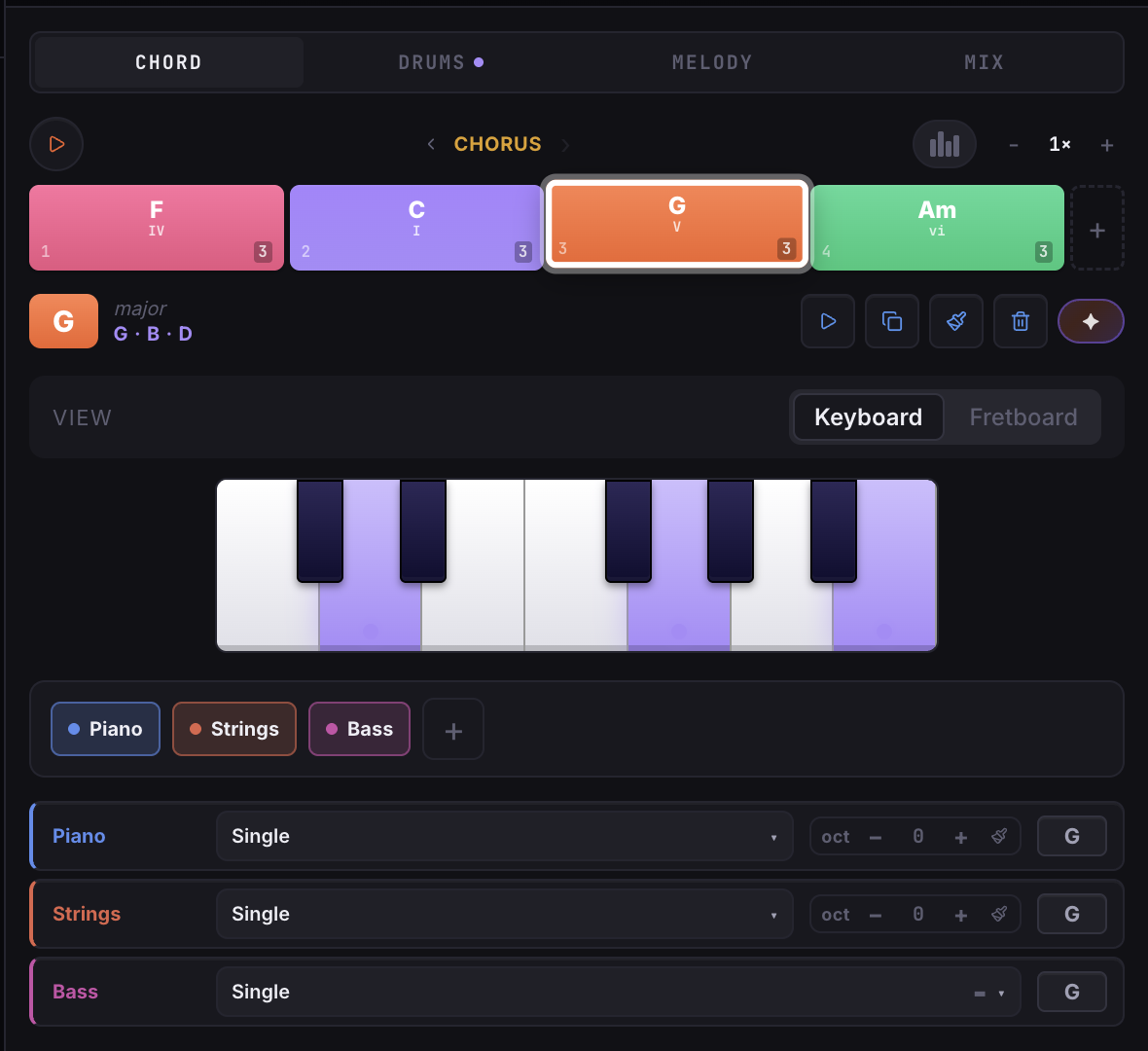
1. I–V–vi–IV — the axis progression In C: C–G–Am–F. In G: G–D–Em–C.
The most widely used progression in pop for the last thirty years. The vi gives a minor moment that adds emotional depth without a key change, and the IV resolves the phrase naturally. It works in ballads, indie rock, folk, country, and mainstream pop. The Axis of Awesome famously demonstrated this by layering dozens of hit songs over the same loop — and they only scratched the surface.
2. vi–IV–I–V — same chords, starts on the minor In C: Am–F–C–G.
Rotate the starting point to the vi and the mood shifts from confident to wistful. The harmony is identical — the same four chords in the same sequence — but where you begin shapes the emotional tone. This version sounds more searching or melancholic, which makes it work better for introspective lyrics.
3. I–IV–V–I — three-chord rock and country In C: C–F–G–C. In G: G–C–D–G.
The most fundamental harmonic movement in Western music. The V wants to resolve to I, and the IV prepares the V. This is the backbone of blues, rock and roll, country, and gospel. It's direct, confident, and leaves no harmonic ambiguity. When you want a song that feels resolved and grounded, this is the framework.
4. I–vi–IV–V — the 50s turnaround In C: C–Am–F–G. In G: G–Em–C–D.
Doo-wop, early rock and roll, and countless pop standards use this. It's smoother than I–IV–V because the vi acts as a bridge between the tonic and the subdominant. The circular V–I resolution at the end makes it easy to loop, and the sequence has a nostalgic quality that modern writers use deliberately for retro effect.
5. I–V–vi–iii–IV — adds the iii In C: C–G–Am–Em–F.
Adding the iii chord before the IV gives the progression more harmonic sophistication. The iii (Em in C) is built on the mediant and shares two notes with the tonic chord, so it doesn't break the key feeling — it deepens it. This five-chord sequence has a flowing, slightly more complex quality that works well for slower tempos and more elaborate chord-melody arrangements.
6. ii–V–I — jazz-pop turnaround In C: Dm–G–C. In G: Am–D–G.
The most satisfying resolution in tonal music. The ii chord prepares the V, which resolves to I with the strongest pull in the harmonic system. Jazz musicians use this constantly, but it appears in pop ballads and R&B whenever the writer wants a moment of complete, clean resolution. Even two bars of ii–V–I at the end of a phrase can make the landing feel earned.
How to make a familiar progression feel fresh
The progression is not the song. The same four chords can produce hundreds of different songs depending on how you deploy them.
Vary the rhythm. I–V–vi–IV strummed on beats 1, 2, 3, 4 sounds completely different from the same changes played with a syncopated pattern. The harmonic content is identical; the groove is entirely different.
Add a sus4 on the V chord. Delaying the resolution of the V by holding a suspended fourth before releasing to the major third gives the dominant chord a brief moment of ambiguity. Gsus4–G–C sounds more earned than G–C.
Change the bass note. Playing I/3 (C/E in C major) puts the third in the bass instead of the root. This creates a smoother step-wise bass line when moving to IV (F) and gives the chord a slightly suspended, open quality. Slash chords are an easy way to add harmonic interest without introducing new chord changes.
Modulate up a half step for the final chorus. Taking the key up a semitone going into the last chorus is one of the oldest tricks in pop arrangement. It creates an automatic emotional lift without changing the progression or the melody — the ear reads the upward shift as intensity.
The how to write a chord progression guide covers the underlying theory if you want to understand why these moves work rather than just how to execute them.
Pick one and start writing
Open the free chord progression generator, enter I–V–vi–IV in a key that feels natural for your voice, and loop it until a melody appears. Once you have a melodic idea, the progression stops mattering — it becomes the foundation you're building on, not the thing you're thinking about. That's exactly how it should work.
For a focused look at how four-chord songs use this approach, see four-chord songs.
Try it in LandChords
Pick a key, add chords by scale degree, and hear them play back.
Switch key above to transpose ↑