The Four-Chord Song: Why I–V–vi–IV Powers Half the Hits
In 2009, the comedy group Axis of Awesome performed a medley that stitched together dozens of pop hits — all played over the same four chords. The audience laughed. But the joke lands because the observation is true: I–V–vi–IV underlies an enormous number of hit songs, across generations and genres. And that's not a flaw in those songs. It's exactly why the progression works.
Familiarity lowers the bar to emotional connection. When a listener's ear already knows the harmonic language — even unconsciously — it doesn't have to work to process the harmony. That cognitive ease frees up attention for the melody, the lyric, the performance. The chord progression becomes invisible, doing its job below the surface while everything else does the work of making the song memorable.
Why these four chords work
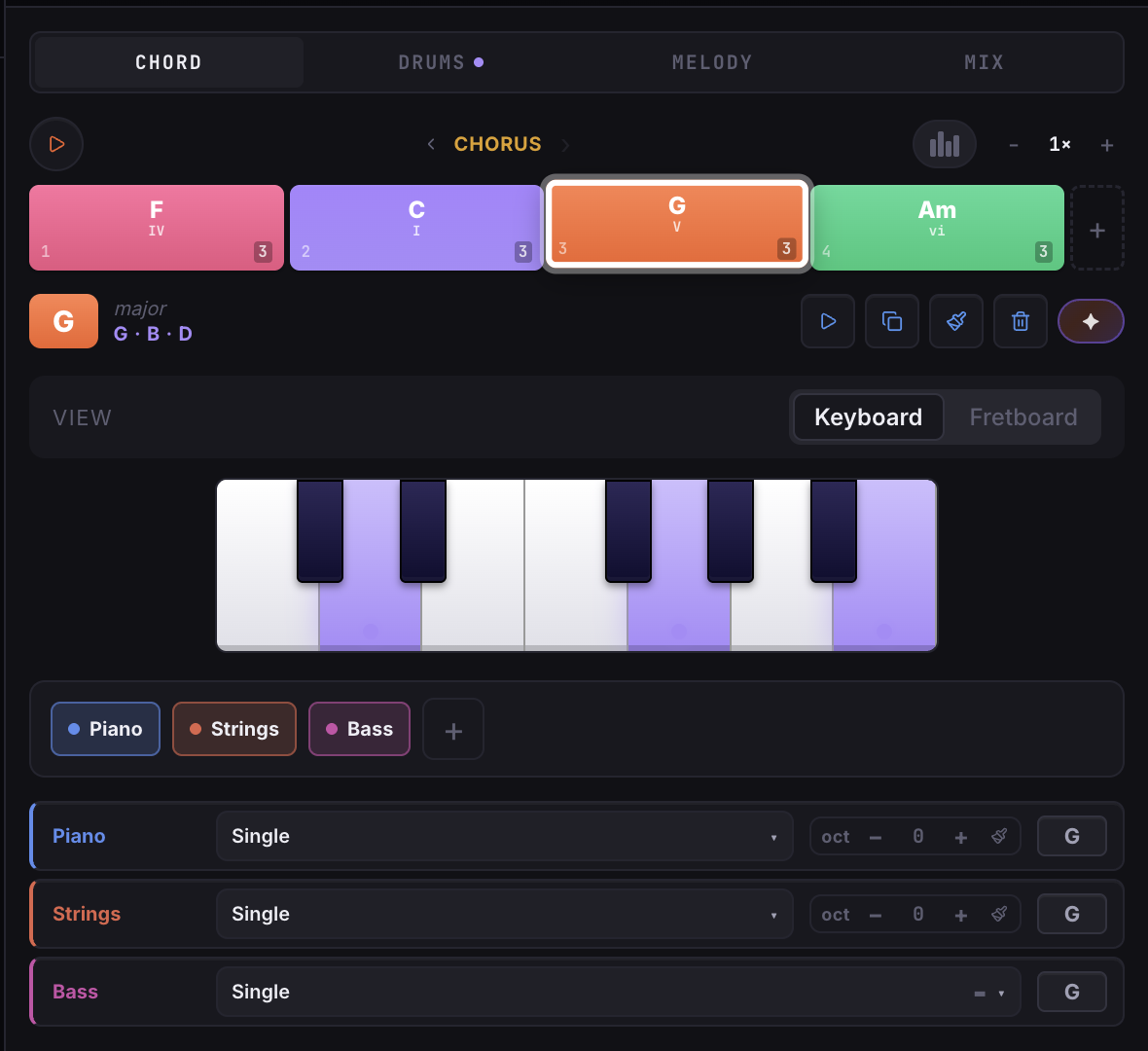
The reason I–V–vi–IV is so effective is that it covers all three harmonic functions in a single four-bar loop.
The tonic function — the feeling of home — is handled by the I chord. The dominant function — tension that wants to resolve — is handled by the V. The subdominant function — the preparation before the dominant — is handled by the IV. Together, those three functions give the ear complete harmonic satisfaction: departure, tension, and arrival, cycling continuously.
The vi chord is the one that adds emotional depth without complicating the structure. It's the relative minor — in C major, that's Am — and it shares two notes with the I chord (C major contains E and G; Am contains A, C, and E). So the vi feels related to home while adding a moment of minor color. That minor moment is why I–V–vi–IV never sounds naively cheerful. There's a small shadow in the loop, and the ear finds that honest.
Four bars, four chords, all three harmonic functions, one touch of minor tension. The construction is genuinely efficient.
Famous songs that use it
The same Roman numerals in different keys produce entirely different songs. That's the point — the progression is a container, not an identity.
- "Let It Be" — The Beatles, in C: C–G–Am–F
- "No Woman No Cry" — Bob Marley, in C: C–G–Am–F
- "With or Without You" — U2, in D: D–A–Bm–G
- "Don't Stop Believin'" — Journey, in E: E–B–C#m–A
- "Someone Like You" — Adele, in A: A–E–F#m–D
- "Payphone" — Maroon 5, in Eb: Eb–Bb–Cm–Ab
- "Despacito" (verse) — Luis Fonsi, in B minor rotation: Bm–G–D–A
- "Stay With Me" — Sam Smith, in A: A–E–F#m–D
Notice that the emotional character of each song is completely different — reggae, arena rock, soul, Latin pop, ballad. The chord progression is constant across all of them; everything else is the song.
Rotating the start
One of the most useful techniques with this progression is changing which chord you begin on. The same four chords produce a measurably different emotional result depending on where the loop starts.
vi–IV–I–V — starting on the relative minor (Am–F–C–G in C)
Beginning on the vi moves the emotional center from confident to searching. The phrase opens on a minor chord, which shifts the mood toward introspective or wistful before the I chord provides a moment of resolution. This rotation appears throughout pop for verses and pre-choruses where the lyric is more inward.
IV–I–V–vi — starting on the subdominant (F–C–G–Am in C)
Starting on IV gives the progression an open, floating quality. The tonic (I) follows the subdominant rather than initiating the phrase, which removes the sense of a strong beginning. This works well for intros and bridges where you want the energy to gather rather than assert.
V–vi–IV–I — starting on the dominant (G–Am–F–C in C)
Starting on V creates immediate tension. The dominant wants to resolve, and delaying that resolution by cycling through vi and IV before reaching I creates anticipation. This rotation is less common but works well for building energy into a chorus.
How to make it sound like your song
The progression is a foundation. Everything else is the song.
Melody is the primary differentiator. Two different melodies over I–V–vi–IV produce songs that feel nothing alike. The melody uses the chord tones as anchors and the passing tones as motion. Where the melody lands on the beat, how it moves between chords, what rhythmic patterns it uses — those choices are uniquely yours and have nothing to do with the chord progression.
Lyric rhythm is the second differentiator. The natural stress pattern of your words determines where the beats land and how the melody flows. Two songs with the same melody rhythm but different lyrics will feel like different songs. Your lyric is doing more rhythmic work than most writers realize.
Tempo changes the genre and mood. At 65 bpm with a slow piano, I–V–vi–IV sounds like a ballad. At 130 bpm with strummed guitar, it sounds anthemic. At 95 bpm with a reggae off-beat strum, it sounds like Bob Marley. The chords are identical; the feel is entirely different.
Arrangement — which instruments play, how they're voiced, what register the chords sit in — is the final layer. A string quartet playing I–V–vi–IV sounds nothing like a distorted guitar playing the same chords. The harmonic content is the same; the texture, weight, and emotional color are different.
The chord sequence is table stakes. It's the minimum required to have something to sing over. The song is everything built on top of it.
When to go beyond it
I–V–vi–IV works for verses and choruses, but relying on it for the entire song can feel formulaic — especially if you're writing something that needs to develop emotionally across its runtime.
The bridge is the most natural place to introduce contrasting harmony. After the second chorus, a bridge with genuinely different chord movement creates the kind of contrast that makes the return to I–V–vi–IV feel like a release rather than a repetition.
Good bridge options that work as contrast:
ii–V–I (Dm–G–C in C): The most satisfying resolution in tonal music. Clean, complete, and slightly jazzy. The ii sets up the V; the V resolves to I with maximum pull. Coming out of a ii–V–I into the final chorus of I–V–vi–IV will feel like an arrival.
I–iii–IV–V (C–Em–F–G in C): Stays in major but uses the iii chord for sophistication. The mediant adds a slightly more complex color to the tonic before the phrase moves toward IV and V. This creates contrast without leaving the major key feeling.
IV–V–vi (F–G–Am in C): Ends the bridge on the vi, which is the same chord that opens the next bar of I–V–vi–IV. It makes the return seamless — the bridge and the chorus connect through the minor chord, and the I at the top of the final chorus feels like resolution.
For a broader look at how these four chords sit within the full landscape of pop chord writing, see best chord progressions for pop songs.
Try it
The free chord progression generator lets you enter I–V–vi–IV in any key and hear it loop immediately. Start by picking a key that sits comfortably for your voice, loop the progression, and see what melody appears without trying to force one. The loop is the frame — the melody is the painting. For more on structuring a song once you have the progression, how to write a chorus covers the next step.
Try it in LandChords
Pick a key, add chords by scale degree, and hear them play back.
Switch key above to transpose ↑