Minor Chord Progressions: Moody, Dark, Emotional Sequences
Minor keys are not just "sad." That label undersells the range. Minor can be dark, mysterious, introspective, tense, exotic, soulful, or melancholic — and which quality comes through depends almost entirely on which minor scale you're using and how you move between the chords. Natural minor, Dorian, and Phrygian each have a distinct personality. Knowing which one you're in, and when to borrow from another, gives you a much wider palette than "minor = sad."
Natural minor progressions
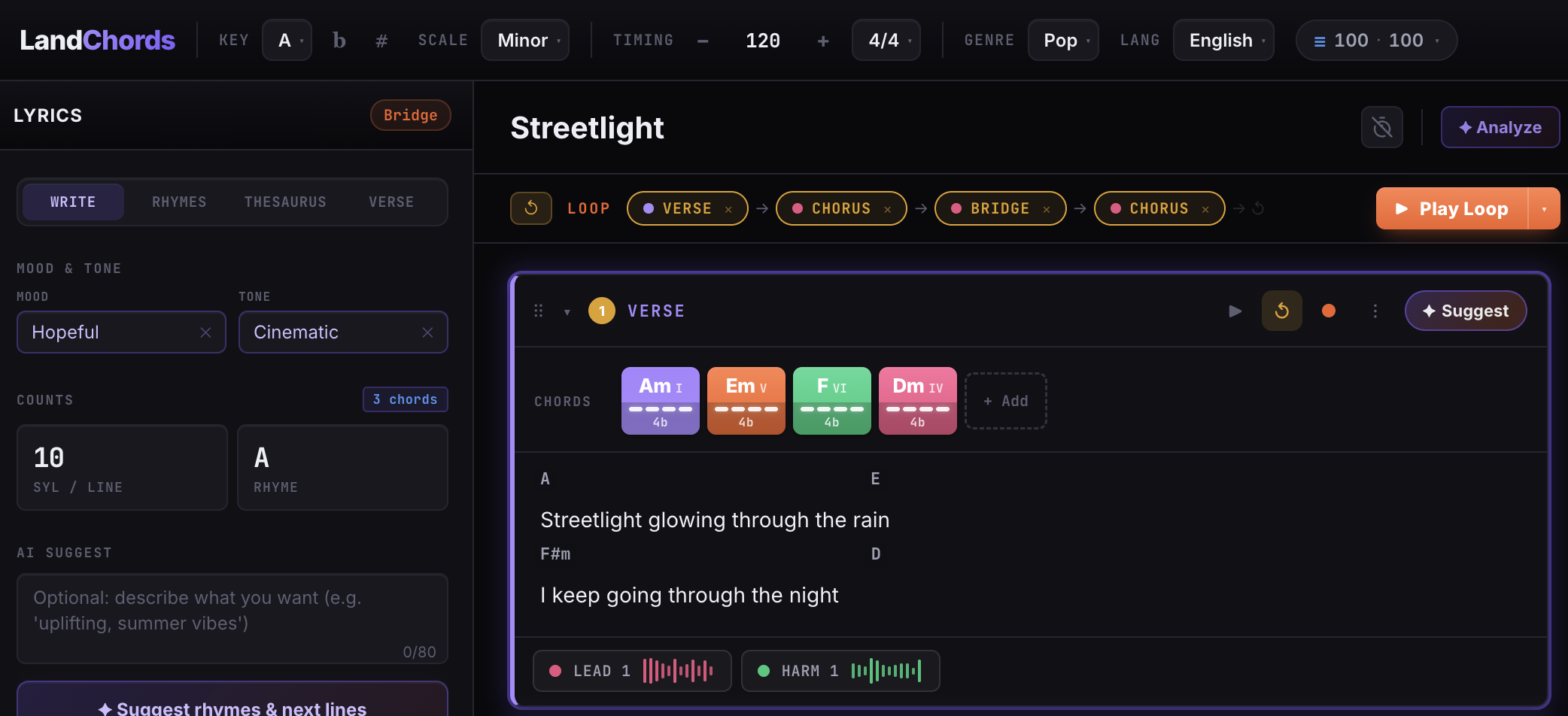
Natural minor — also called the Aeolian mode — is the most common minor scale. In A minor, the notes are A B C D E F G. The chords built from those degrees are:
i (Am), ii° (Bdim), III (C), iv (Dm), v (Em), VI (F), VII (G)
The backbone of natural minor writing is i–VII–VI. In A minor: Am–G–F. This three-chord move appears in thousands of songs because it uses three of the most comfortable chords in the scale and creates a clear sense of minor tonality without strong resolution. The VII chord (G in Am) doesn't have the assertive dominant pull of a raised fifth-degree chord, so the progression floats rather than resolves — which is exactly what a lot of minor-key writing needs.
From there, a longer sequence like i–VII–VI–VII walks the outer chords of the scale back and forth in a loop that feels circular and slightly urgent. For a longer phrase, i–iv–VII–III–VI–VII–i walks the full natural minor — tonic, to subdominant, to subtonic, to mediant, to submediant, then back — and covers the harmonic field of the mode completely.
For more depth on natural minor progressions with an emotional focus, see sad chord progressions.
Dorian mode progressions
Dorian is built like natural minor but with one change: the sixth degree is raised by a semitone. In A Dorian, the notes are A B C D E F# G — the F# (instead of F natural) makes the iv chord major.
That one raised note changes the character of the mode significantly. In natural minor, the iv is minor (Dm in Am). In Dorian, the IV is major (D major in A Dorian). The i chord stays minor — so you have a minor tonic with a major fourth. That combination has a specific quality: minor but with lift. Soulful. Searching. Hopeful despite the darkness.
The signature Dorian move is i–IV: Am–D. That alternation between minor tonic and major fourth is the foundation of a huge amount of R&B, soul, and funk. Carlos Santana built entire songs on it. Stevie Wonder used Dorian progressions throughout his work. The mode has brightness and earthiness simultaneously, which makes it one of the most emotionally versatile minor sounds.
For a longer Dorian progression, try i–VII–IV–i: Am–G–D–Am. The major IV appears at the peak of the phrase, giving a moment of openness before returning to the minor tonic.
Phrygian and exotic minor
Phrygian is built from the third degree of the major scale, which gives it a distinctive flat second degree — the bII chord. In A Phrygian, the notes are A Bb C D E F G. That Bb gives you a Bb major chord as the bII, sitting a half step above the tonic.
The signature Phrygian move is bII–i: Bb–Am in A Phrygian. That half-step descent from the flat two to the minor tonic is one of the most tense, dramatic cadences in Western music. It resolves, but barely — the bII is so close to the tonic that the resolution feels like a controlled fall rather than a satisfying arrival.
This sound dominates flamenco, Spanish classical guitar, and metal. You hear it in the intro riff of countless heavy metal songs — the minor i chord with the bII hovering above it like a threat. In Spanish folk music, the Phrygian cadence is structural, not decorative.
A fuller Phrygian phrase: i–bII–i or i–bVII–bVI–bII–i. The bVII and bVI (G and F in A Phrygian, same as natural minor) set up the dramatic half-step resolution of bII–i. This kind of descending chromatic approach to the tonic is the harmonic backbone of a lot of metal and classical Spanish music.
Borrowing from the parallel major
One of the most useful techniques in minor-key writing is reaching into the parallel major for a chord that doesn't belong to the minor scale. The parallel major shares the same root but uses a different scale — A major and A minor are parallel.
The most common borrow is the IV major chord. In A minor, the natural iv chord is Dm. But you can substitute D major — the IV of A major — into a minor-key progression. The effect is a sudden brightening, as if a shaft of light cuts through the darker harmonic environment. This is especially effective at the peak of a chorus or at the turnaround point in a verse.
The Picardy third is the ultimate parallel-major borrow: ending a minor-key piece or section on the I major chord instead of i minor. In A minor, that means resolving to A major instead of Am. The effect is striking — a definitive, almost defiant brightness at the point where the ear expects a minor landing. Baroque composers used it constantly; modern writers use it for unexpected emotional punch at the end of a section or song.
Choosing your mode
The choice of mode is the first creative decision in minor-key writing, and it shapes everything that follows.
Natural minor (Aeolian) is the right choice when you want melancholy, introspection, or weight. The all-minor scale and the floating, non-resolving VII chord give it a somber quality that suits sad ballads, folk, and moodier rock.
Dorian is the right choice when you want soulful, searching, or bittersweet. The raised sixth and major IV give it warmth within the minor frame. R&B, soul, and blues-influenced writing tends to live here.
Phrygian is the right choice when you want tense, dramatic, or exotic. The flat second is aggressive and unresolved. Metal, flamenco, and Spanish-influenced music use it for its edge.
Knowing which mode you're in also tells you which chord to reach for when the progression needs to shift. Start in natural minor, borrow the Dorian IV for the hook, and end the song with a Picardy third. Each of those moves has a clear sonic logic, and the listener feels the intent even without knowing the theory.
Use the free chord progression generator to set up a minor key and experiment with each mode's characteristic chord — the minor iv for Aeolian, the major IV for Dorian, the bII for Phrygian — and hear directly how each one changes the emotional color.
For the underlying mechanics of how chord progressions are constructed, how to write a chord progression is a good starting point.
Try it in LandChords
Pick a key, add chords by scale degree, and hear them play back.
Switch key above to transpose ↑