Happy Chord Progressions: Bright and Uplifting Sequences
The ingredients of a bright, happy-sounding song are not mysterious. Major keys, tempos above 100 bpm, upward melodic movement, and open harmonic resolution are the primary signals. When the ear hears a raised third (the defining interval of a major chord), it registers that as light rather than heavy. Build from there, and the harmonic foundation does a lot of the emotional work before the melody even starts.
The chord progression sets that foundation. These are the sequences that consistently produce a bright, uplifting, or joyful character — with Roman numerals so they work in any key.
Simple bright progressions
I–IV–V–I is the most resolved, confident-sounding progression in Western music. In C: C–F–G–C. In G: G–C–D–G. The V wants to resolve to I (that pull is the foundation of tonal harmony), and the IV prepares the V naturally. When you play this sequence at any tempo above 80 bpm and strum it cleanly, it sounds decisive and open. Nothing hangs in the air; everything lands.
This is the backbone of blues, country, rock and roll, and gospel. The three-chord song is not a limitation — it's a clarity of purpose. I–IV–V gives the melody maximum room because the harmony is doing its job simply.
I–IV–I–V is the country-bounce variant. In C: C–F–C–G. Returning to I before the V gives the progression a light, bouncy quality. The extra pass through the tonic makes the phrase feel energetic and grounded rather than searching. This is the feel behind a lot of uptempo country and folk.
Adding color
I–iii–IV–V introduces the iii chord, which adds sophistication without losing brightness. In C: C–Em–F–G. The iii (Em in C major) shares two notes with the I chord, so it never feels foreign or disruptive — it deepens the tonic color before moving to IV. This is more interesting than plain I–IV–V while staying clearly in major-key territory.
The iii chord has a slightly more pensive quality than I, so this progression has a hint of reflection — thoughtful brightness rather than uncomplicated joy. Good for songs that are uplifting but not naive.
I–II–IV–I uses a borrowed major II chord, which in C would be D major instead of the diatonic Dm. That raised third in the II chord (F# in D major, against F natural in the key of C) creates a "sparkle" effect — a brief moment of harmonic sharpness before landing on IV. Gospel and uplifting pop use this move regularly. It creates energy and momentum, and the resolution to I feels earned.
This is sometimes called the "secondary dominant of the IV" move — D major naturally wants to resolve to G (the V of D is A, but in the context of the key of C, the D major acts as a pivot toward F). The harmonic logic is slightly complex, but the ear hears it as a lift, not a puzzle.
The anthemic four chords
I–V–vi–IV is often associated with the wistful or bittersweet sound of pop ballads. But that quality is almost entirely about tempo. At 65 bpm with a slow piano arrangement, it sounds melancholic. At 130 bpm with strummed guitar and a driving kick drum, it sounds anthemic — energetic, hopeful, propulsive.
The same four chords. Completely different emotional result.
This is worth internalizing: the chord progression is a container, not the content. Tempo, rhythm, register, arrangement, and melody fill the container and determine what it sounds like. I–V–vi–IV at an anthemic pace is behind some of the most overtly joyful songs in pop music. The vi chord adds a moment of minor color that keeps it from feeling shallow — it gives the brightness something to push off against.
If you want an uplifting feel, don't rule out I–V–vi–IV because of its associations with sad songs. Just change the tempo. The sad chord progressions guide explores the same progression from the opposite emotional angle, which is a useful demonstration of how much context shapes the result.
The IV–I loop
Alternating between IV and I — just those two chords — creates one of the most open, bright, floating sounds in tonal music. In C: F–C. In G: C–G.
Gospel and praise music built entire genres on this. The IV–I resolution is gentler and less assertive than V–I, which gives it an open, non-conclusive quality. It doesn't push toward resolution so much as hover in a state of harmonic openness. Uplifting without urgency.
Two chords leave a great deal of room for melody. With only IV and I to deal with, the harmonic environment is simple enough that the vocal line can move freely without fighting the harmony for space. Many great hooks were written over two-chord loops.
Tempo and rhythm matter as much as the chords
This point deserves emphasis because it's the most commonly overlooked variable. Play I–V–vi–IV at 60 bpm on a slow piano and it sounds mournful. Play the exact same progression at 135 bpm with a punchy guitar strum and it sounds like a stadium singalong.
The notes are identical. The emotion is not.
Before you change the chord progression looking for a brighter feel, try increasing the tempo and adding rhythmic energy. A faster strum pattern, a syncopated rhythm, or a higher piano register will often do more for the brightness of a song than switching from vi–IV to ii–V.
The best chord progressions for pop songs guide goes deeper into how these progressions function across different emotional contexts.
Try a bright progression
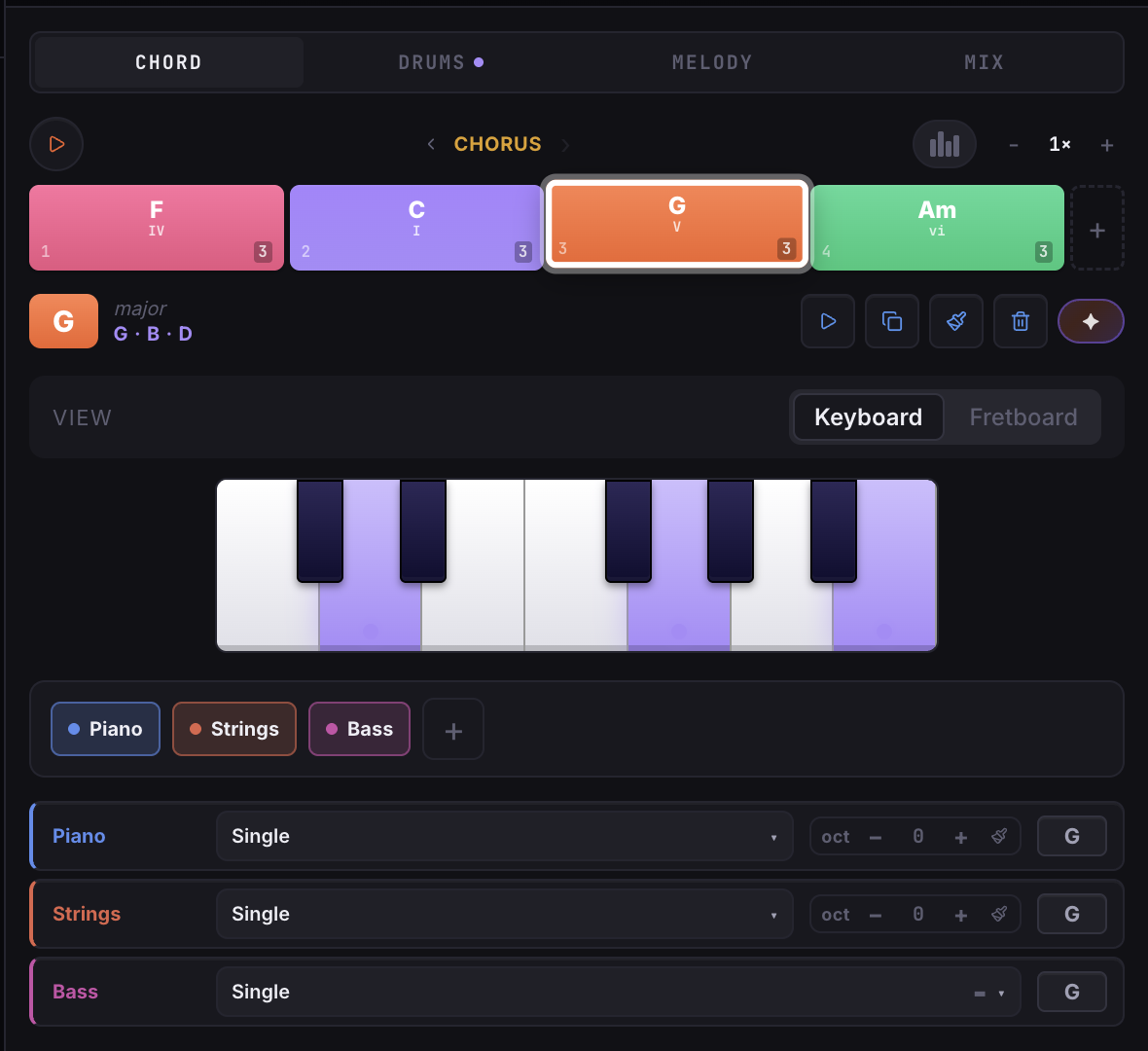
The free chord progression generator lets you enter any of these progressions and play them back at different tempos, with no sign-up. Set up I–IV–V in your key, loop it at 120 bpm, and see what melody appears. Then try swapping in a iii chord between I and IV to see how the color changes. Brightness has a lot of shades — find the one that fits your song.
Try it in LandChords
Pick a key, add chords by scale degree, and hear them play back.
Switch key above to transpose ↑