How to Write a Verse That Sets Up Your Chorus
The verse has a misunderstood job. Songwriters often treat it as the place to put everything they wanted to say that did not fit in the chorus — a collection of observations, details, and feelings loosely arranged until the chorus arrives. But that approach produces verses that feel like waiting rooms: necessary to move through, not rewarding to inhabit.
A verse has one purpose: to make the chorus feel inevitable and earned. Every line, every image, every harmonic choice in the verse exists in service of that arrival. The moment the chorus hits, the listener should feel that this is exactly where the song was always going.
Set the scene in the first two lines
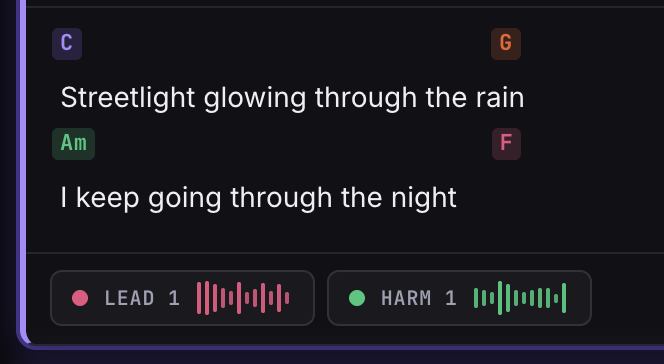
The first verse establishes the world of the song. Give the listener something specific and concrete to stand inside — a who, a where, a when. Not a theme, not a feeling, not an abstract statement of what the song is about. A scene.
"We drove home in silence on a Tuesday in November" is a scene. "Things were complicated between us" is a summary. The scene earns its emotional weight by trusting the listener to feel what the situation implies, without being told how to feel it.
Concrete details do several things at once. They establish credibility — the listener believes this is real because it is specific. They create a visual anchor that grounds the rest of the verse. And they leave interpretive room for the listener to project their own experience into the situation, which is what makes a lyric feel personal rather than generic.
Avoid starting the first verse with "I feel" or "I know" or any sentence where the emotional conclusion comes before the evidence. Let the image lead. The feeling follows.
Build toward the chorus
Once the scene is set, the verse should not stay flat. Each subsequent line should raise the emotional stakes — slightly, but perceptibly. The verse is not a loop; it is a ramp.
Think of it this way: if the chorus is the moment where the emotional pressure releases, the verse is the process of building that pressure. Line one establishes the situation. Line two deepens it or complicates it. Line three or four should push the emotional logic to the edge of the resolution the chorus is about to provide.
The last line of the verse is the most important structural element in the section. It is the launchpad. It should create a direct forward momentum into the chorus — a question that needs answering, a tension that needs releasing, a statement that raises the emotional stakes to their highest point before the drop.
Test it this way: sing the last line of the verse and immediately start the chorus. If the transition feels natural and earned, the launchpad is working. If the chorus feels like it comes from nowhere, the last line of the verse needs revision.
Keep the melody lower than the chorus
This is a melodic instruction, but it shapes how you write the lyric. The verse melody should stay in the lower half of your vocal range. Not monotonous — there should be contour and movement — but restrained relative to the chorus.
The reason is structural: the chorus needs to feel like a lift. If the verse melody is already reaching for the ceiling, the chorus has nowhere to go. The emotional release of the chorus arrival depends on the verse having held something back.
When you are developing the verse lyric, listen to where the melody wants to go on each line. If you find yourself instinctively reaching for a high note, save it. Write a version of the line that fits within the lower register. Then when the chorus arrives and the melody climbs, the listener feels the release even if they could not tell you why.
This constraint also tends to produce better lyrics. Lines written to fit a lower, more conversational melody tend to be more naturalistic and specific. The heightened, declarative lines — the ones that feel like proclamations — usually belong in the chorus, where the melody supports that kind of energy.
Make verse 2 advance the story
Verse 1 and verse 2 share the same chord progression and the same melody. The only thing that changes is the lyric. This means verse 2 is not a second attempt at verse 1 — it is the next chapter.
If verse 1 establishes the situation, verse 2 should develop it: a new detail, a complication, a revelation, a shift in perspective. The story should have moved forward. The listener who has already heard the chorus once is now primed to understand it more deeply, and verse 2's job is to give them the additional context that makes the second chorus hit harder than the first.
A useful diagnostic: read verse 1 and verse 2 back to back and ask whether the song would lose anything if verse 2 were removed. If the answer is no — if verse 2 repeats emotional content or observation that verse 1 already covered — then verse 2 is not doing its job. Go back and find the next development in the story.
The same chord progression and melody means the structure is fixed, but the emotional content should evolve. Verse 2 is where the song deepens.
How long should a verse be?
Four to eight lines is the standard range. Shorter verses can feel underdeveloped, like the song is in a hurry to get to the chorus before it has earned it. Longer verses lose momentum — the listener starts waiting for the payoff and the waiting becomes its own distraction.
Within that range, every line should be load-bearing. A verse is not a place to fill time; it is a place to build pressure. If a line is doing nothing — not advancing the story, not deepening the image, not escalating the tension — cut it. A six-line verse where every line earns its place is stronger than an eight-line verse with two lines that drift.
The last line is the one that matters most and the one that most often needs revision. If the verse builds well for five lines and then the sixth line dissipates the tension before the chorus, the structure fails. The last line should feel like a door held slightly open, not a destination reached.
Understanding what a verse needs to do changes how you write it. For the other side of the equation — what the chorus needs to deliver in order to justify everything the verse built — the guide on how to write a chorus covers that territory in full. For the complete verse-chorus-bridge structure, that guide addresses how all three sections relate to each other as a whole.
And for writing the lyrics themselves — finding images, choosing rhyme schemes, testing lines against the melody — that guide picks up where this one leaves off.