How to Write Song Lyrics from Scratch
Lyrics are not poetry set to music. That distinction matters more than it sounds. Poetry is designed to be read — ideally slowly, on a page, with room for the eye to linger. Song lyrics are designed to be sung: they move through time at a fixed tempo, they live inside a melody, and they have to carry meaning while the listener is also processing harmony, rhythm, and texture all at once. A lyric that looks flat on the page can be devastating when sung. A lyric that reads beautifully can fall completely apart the moment it meets a melody.
This is a practical guide to writing lyrics from the blank page — how to find a starting point, how to develop an idea, how to make rhyme feel natural instead of forced, and how to know when you are actually done.
Start with an image, not a statement
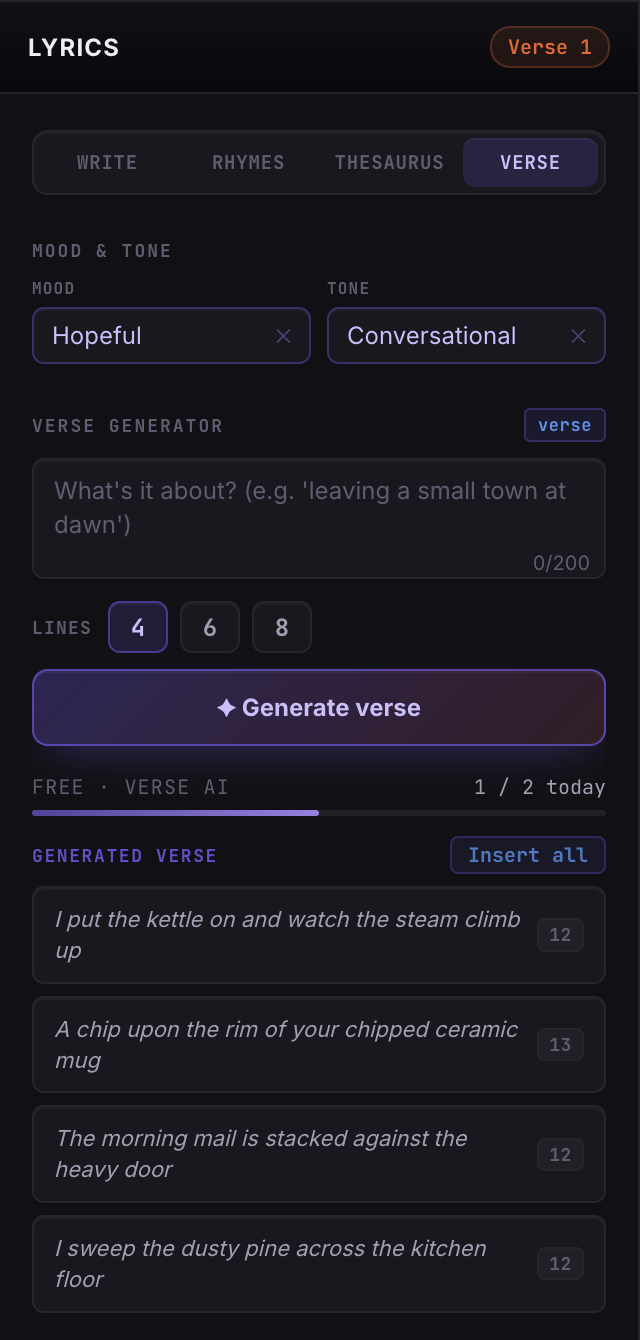
"I miss you" is a statement. "Your coffee mug still sits on the counter" is an image. These communicate the same emotional fact, but they work completely differently on a listener.
Statements tell the audience how to feel. Images show them a specific, concrete moment and let them arrive at the feeling themselves. The emotional conclusion comes from the image, not from labeling the feeling. That arrival — the moment when the listener understands what the song is really about — is one of the most powerful things a lyric can do.
When you sit down to write, ask yourself: what is the most specific thing about this situation? Not "it was sad" but "the last exit on the interstate, where you used to always take the wrong turn." Not "I was angry" but "the way you sorted the cutlery drawer while I was talking." Specific details are universally recognizable in a way that abstract statements rarely are. The listener who has never sorted a cutlery drawer during an argument still knows exactly what that means.
Start your song by writing five to ten concrete images related to the subject. Do not write lines yet. Write observations. The lyric will emerge from them.
Write to the chord structure
Before you write a single line, know your chord progression. The harmony shapes the emotional curve of the song, and your lyrics need to work with that curve, not fight against it.
A V chord creates tension; your lyric at that moment should feel unresolved. The I chord resolves; that is where your most settled, conclusive lines should land. A minor iv chord adds weight and darkness; if you want a line to feel heavy, write it over that change.
In practical terms: play the chord progression on loop while you write. Try to land important words — especially the last word of a phrase — on chord changes. A line that resolves with the harmony feels inevitable. A line that fights the chord change feels awkward, even if the listener can't articulate why.
This is also why writing lyrics after you have the chord progression is almost always easier than writing lyrics first. The chords give you an emotional shape to work with. You are not inventing the feeling from scratch; you are finding the words that fit the feeling the music is already creating.
Choose a rhyme scheme and stick to it
ABAB, AABB, ABCB — pick one rhyme scheme for each section and hold it consistently through the whole song. The specific scheme matters less than the consistency. Listeners internalize the pattern within the first verse, and they hear the rest of the song against that expectation. When the pattern breaks unexpectedly, it feels unfinished, even if they cannot name why.
A few practical notes:
Perfect rhymes feel resolved. Use them at emotional landing points — the end of a chorus, the turn in a bridge, the line that delivers the song's central statement.
Slant rhymes feel conversational. "Rain" and "flame" share a vowel sound but not an exact rhyme. Slant rhymes are often more natural than perfect rhymes and less likely to distort a line just to land on a matching word. They are not a compromise — used intentionally, they are the better choice.
Forced rhymes kill credibility. If you find yourself writing a line that only exists to provide a rhyme for the line above it, delete both and start over. Listeners sense a forced rhyme even if they do not consciously identify it. It signals that the lyric is serving the rhyme scheme instead of the other way around.
For a deeper look at finding rhymes without forcing them, that guide covers perfect, slant, and internal rhyme in more detail.
Write more than you need
The first line you write for a section is almost never the best one. It is the first line you thought of, which means it is probably the most obvious interpretation of the idea. Write it down anyway — then write five more versions of the same line.
A useful target: write three times as many lines as the section actually needs. If the verse calls for eight lines, write twenty-four candidates and cut the weakest sixteen. This feels wasteful until you do it the first time and discover that line seventeen is significantly better than line one.
This approach also solves the problem of weak lines. Every verse has a weakest line — the one that exists to connect the stronger ones around it. When you have a large pool to choose from, even the weakest line in the final section has been through a selection process. The floor is higher.
Cutting is a skill, and it develops with practice. The question for each line is simple: does this line earn its place, or is it only here because I needed something between the line before and the line after? If it is the latter, the song is better without it.
Sing the lyric, don't just read it
This is the most commonly skipped step in lyric writing, and it costs more than any other omission.
A lyric that reads perfectly on paper can sound completely wrong the moment it meets a melody. Stressed syllables that fall on weak beats create a lurching, off-balance feeling. Long vowels crammed into fast phrases feel rushed. A line with too many syllables forces you to squeeze words together until the meaning is lost.
None of these problems are visible on the page. They only exist in time, and you only hear them when you sing.
As soon as you have a draft of a section, sing it to the actual melody. Not a placeholder melody — the real one, even if it is rough. Listen for:
- Lines where you are rushing or dragging to fit the syllable count
- Words where the stress falls on the wrong syllable
- Phrases that feel awkward in your mouth, regardless of how they look written down
- Moments where you want to breathe but the phrasing does not allow it
Fix those first. The line that works on the melody is the right line, even if it looks simpler on the page. When two lines feel uneven and you cannot hear why, running them through a free syllable counter usually shows the mismatch straight away.
When is a lyric done?
When every line earns its place and the weakest line is still strong enough not to distract from the rest.
That is the full standard. Not when you have written enough words, not when the rhyme scheme is complete, not when you have been working on it long enough that it feels finished. A lyric is done when you can read through it and every single line justifies itself — when nothing is there just to fill space, and nothing is there because you were too attached to cut it.
The fastest way to reach that standard is to sing the whole lyric through from start to finish and notice the moments when your attention wavers. Those moments are the weak lines. Rewrite them or remove them. If you cannot improve them, the section might not need them.
Once the lyrics are written, Lyric Lab → Try it lets you pin words to specific chord changes as you play back the song — so you can immediately hear whether the lyric lands on the right harmonic moment or fights the progression. A practical way to catch the problems that only show up when the words meet the music.