How to Layer Vocals for Thick, Lush Harmonies
Layered vocals transform a bare demo into something that sounds full and produced. Listen to almost any pop or R&B record and what you are hearing is not one voice — it is four, six, sometimes a dozen performances stacked on top of each other. The lead holds the center while doubles thicken it, harmonies add width and color, and ad-libs fill the spaces between phrases.
The good news is that you do not need a studio or a recording engineer to build a vocal arrangement like this. A browser, a microphone, and a multi-track recording tool are all you need. Here is how to build a vocal arrangement layer by layer.
Lead vocal first — always
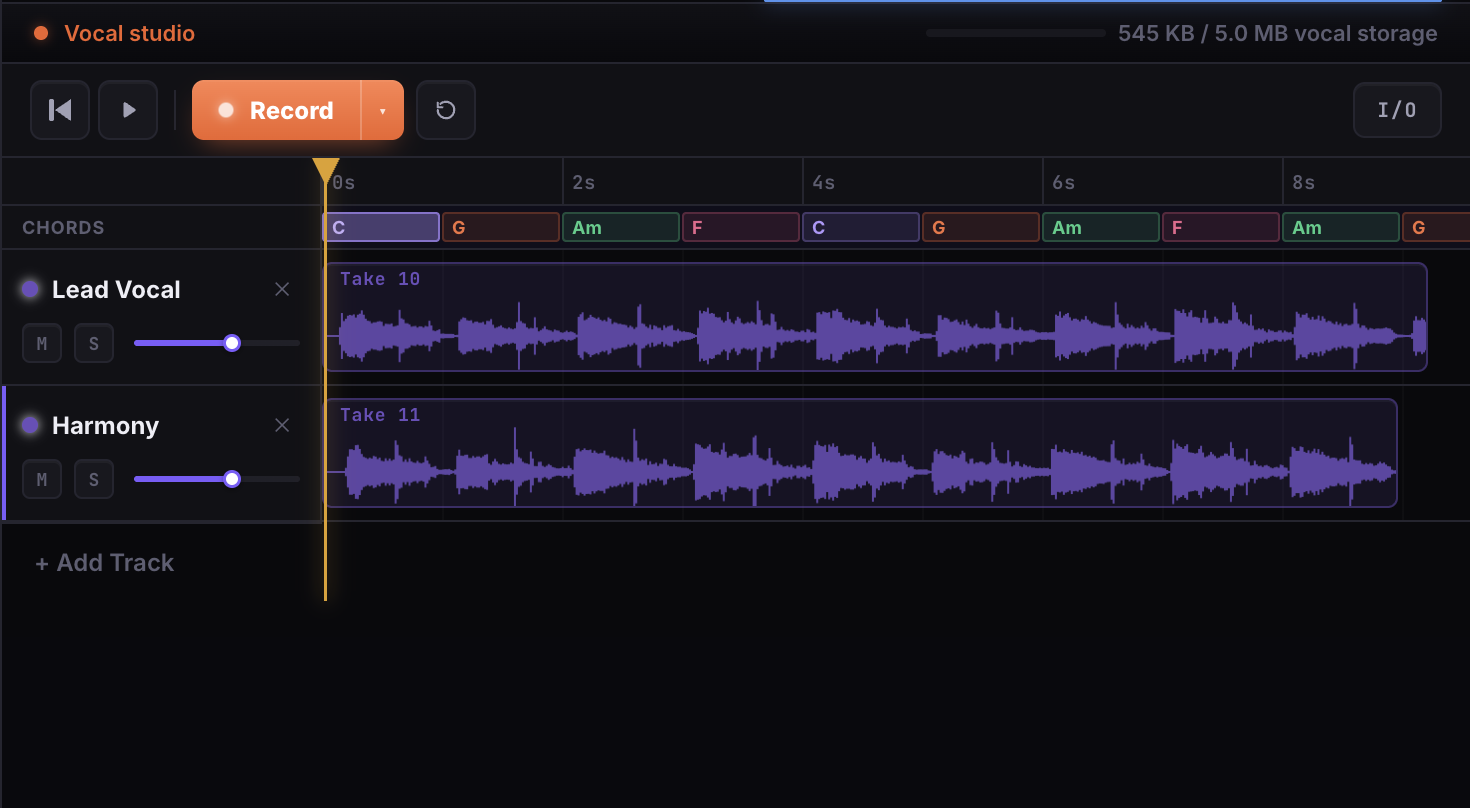
The lead vocal is the timing and pitch reference for everything else you record. Every harmony, every double, every ad-lib you add later will be recorded in relation to the lead. If the lead is off-pitch or rushed, every layer you stack on top of it will fight against it rather than blend with it.
Record the best lead you can before you add a single harmony. That means spending real time on it — three takes, five takes, ten takes if needed. Listen back critically. Does the pitch feel centered? Does the timing feel confident? Is the emotion in the right place?
A weak lead makes every layer worse. A strong lead makes every layer easier to sing and easier to blend.
Once you have a lead you are genuinely proud of, then you can start building.
Doubling the lead
The cheapest and most effective way to make a vocal sound bigger is to record the same melody again on a second track, sung as closely as possible to the original performance.
This is called a "double" or a "doubled vocal." The key is that you are not trying to pitch-correct the double into perfect alignment with the lead. The slight differences — tiny variations in timing, tiny variations in pitch — are exactly what creates the thickening effect. Those imperfections cause the two takes to smear together in a way that sounds natural and wide.
Here is how to record a clean double:
- Listen to your lead on headphones while recording. You are aiming to shadow it as precisely as you can.
- Record the whole phrase in one take rather than punching in and out. Continuous performances feel more natural than edited fragments.
- Trust the process. Even if the double feels almost the same, play both together and notice the difference. It will be immediately obvious.
Keep the double quieter than the lead in the mix — by several dB. A double that is too loud starts competing rather than supporting. You want listeners to feel the size without consciously hearing two separate voices.
Adding a harmony a third above
Once the lead and its double are down, the most impactful next step is a harmony a third above the lead melody.
A third is two scale steps above the note you are singing. If the melody lands on G, a third above is B (in a major key) or Bb (in a minor key). This interval is the most common harmonic interval in Western music for good reason: it sits clearly in the mix without crowding the lead, and it adds color without sounding dissonant.
Before you record, check each note of the harmony against the underlying chord. Harmonies that sit on a chord tone — the root, third, or fifth of whatever chord is playing at that moment — blend naturally. Harmonies that land on a non-chord tone can sound clashing unless you resolve them quickly. If a particular note feels wrong, move it up or down a half step and see if it locks in better.
Record the third-above harmony the same way you recorded the double: full phrases, headphones on, listening to the lead while you sing.
High and low harmonies for a three-part stack
Once you have the lead and the third above, adding a harmony a third below the lead gives you a three-part stack: low harmony, lead, high harmony.
This is the "choir" sound. In gospel and soul music it is sometimes called a "spread." In pop it shows up in pre-choruses and big choruses where the producer wants a moment to feel massive. The three voices cover a range of an octave or more and fill the mid and upper frequency range in a way that a single voice never can.
A few practical notes:
- The third below the lead is often a minor third in a major key. In the key of C, if the lead is on E, the third below is C — which is also the root of the chord. That makes it a very stable harmony.
- Not every moment needs all three parts. A big chorus might use the full three-part stack, while the verse uses only the lead and its double. Contrast between sections gives the stack more impact when it arrives.
- Keep all harmonies quieter than the lead. The lead is always the loudest voice.
Ad-libs and background fills
Ad-libs are the short phrases — "oh," "yeah," "come on," a repeated word or syllable — that fill the gaps between lead vocal phrases. They are the most stylistically expressive layer of a vocal arrangement, and they are also the most frequently overused.
The rule for ad-libs is simple: their job is to support, not compete. An ad-lib that draws attention to itself has failed. An ad-lib that makes the listener feel like the song is breathing and alive has succeeded.
Practically, this means:
- Keep ad-libs shorter and simpler than the lead phrases around them.
- Record them at a quieter level — even quieter than the harmonies.
- Place them in the spaces, not over the top of lead phrases. If the lead is singing, the ad-lib should be waiting.
- Less is more. Two or three well-placed ad-libs in a chorus are more effective than a constant stream.
Mixing layers by ear
Once you have recorded lead, double, third-above harmony, and possibly a third-below harmony and ad-libs, the arrangement is built. Now you need to mix it.
The hierarchy is simple:
- Lead vocal — the loudest. Everything serves the lead.
- Harmonies — several dB lower than the lead. You should clearly hear them, but they should not pull focus.
- Doubles — lower still. They should be felt more than consciously heard. If you can clearly distinguish the double from the lead, it is too loud.
- Ad-libs — the quietest layer. They sit underneath everything.
Use the solo function on each layer to check that every track is doing what you intend. A harmony that sounds like it is blending perfectly in the full mix might reveal a pitch issue when soloed. Fix pitch problems on the individual layer before judging the blend.
Mute each layer in turn and notice what the mix loses. If you cannot hear a difference when you mute a layer, the layer is either too quiet to be worth keeping, or it is already so well blended that it is doing its job perfectly — only you can decide which.
A finished vocal arrangement with four or five layers, mixed well, sounds like one voice that fills the room. That is the goal.
Ready to start layering? See how to record your first vocal demo in the browser, then open the Vocal Studio → Try it and start stacking.