The Circle of Fifths for Songwriters: A Plain-English Guide
The circle of fifths shows up in practically every music theory textbook, usually with very little explanation of why a songwriter would care about it. It looks decorative — a neat diagram of all 12 keys arranged in a ring. But it is actually a practical tool for two specific problems: figuring out which keys are closely related (useful when modulating), and understanding why certain chords from outside a key still sound natural (useful when borrowing chords).
Here is what it actually tells you.
What "related keys" means
The 12 major keys are arranged around the circle so that each key shares the most notes possible with its immediate neighbors. C major and G major are next to each other. They share six of their seven notes — G major just adds one sharp (F#). Moving from a C major song into G major sounds smooth and natural because almost nothing in the harmony changes.
C major and F# major are on opposite sides of the circle. They share only one note. Moving between them sounds dramatic and disorienting — every chord feels like it is in a completely different tonal world.
This tells you something immediately useful: if you want a modulation that feels like a natural lift, move to a key adjacent on the circle. If you want a modulation that sounds jarring or cinematic, leap across the circle.
The most common modulation in pop and country is moving up a fifth — one step clockwise on the circle. A song in C major modulating to G major at the final chorus is one step clockwise. It sounds like a brightening, an elevation, an arrival at a slightly higher emotional register. This works because the two keys share almost all their notes; the move feels like an expansion rather than a departure.
Moving one step counterclockwise (down a fifth, or equivalently up a fourth) is the other smooth option. C to F is one step counterclockwise — warmer, slightly less dramatic than moving clockwise.
The circle as a chord-borrowing guide
Here is where the circle becomes genuinely useful for day-to-day songwriting rather than just key navigation.
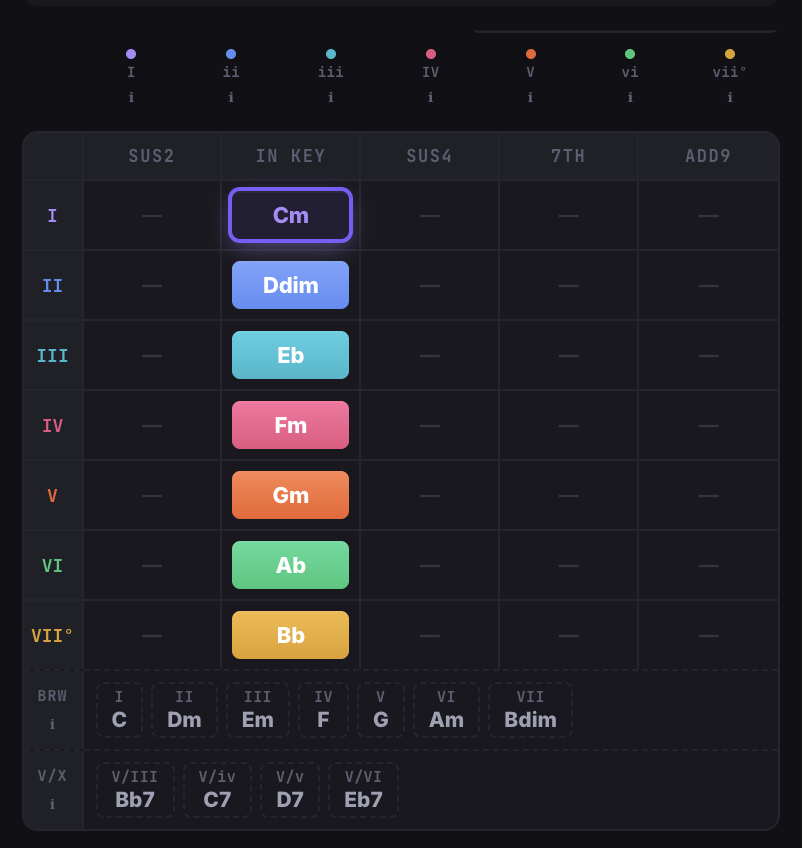
You are working in C major. You want a chord that adds rock or folk grit without sounding like a key change. You want the bVII chord — Bb major in C.
Where does Bb come from? It is the tonic of the key one step counterclockwise from C on the circle: F major. Bb is not in C major's scale, but it comes from a closely related key, which is why it blends in despite being technically outside the key.
The practical rule: the most common borrowed chord in any key is the major chord one step counterclockwise on the circle from your tonic. In C, that is Bb (bVII). In G, that is F (bVII). In D, that is C (bVII). Songwriters use this chord constantly in rock, pop, folk, and country — often without knowing why it works. The circle explains it: you are borrowing from the closest available neighbor.
One step clockwise gives you your V chord — the dominant, the most important chord in the key. C major's V chord is G, which is one step clockwise from C. G major's V chord is D, one step clockwise from G.
Using it to find your key's chords
Three relationships on the circle cover most of what you need for any given key:
- One step clockwise = your V chord (the dominant; creates tension and wants to resolve back home)
- One step counterclockwise = your IV chord (the subdominant; creates smooth movement away from home)
- The inner ring = your relative minor (the vi chord of your major key, which shares the same seven chords)
In C major: clockwise = G (your V), counterclockwise = F (your IV), inner ring = A minor (your vi and relative minor tonic).
In G major: clockwise = D (your V), counterclockwise = C (your IV), inner ring = E minor.
You do not need to memorize all 12 keys cold — you can look them up on the circle and derive these relationships in seconds. Over time they become automatic.
Practical uses for the circle
Choosing a modulation key: Going one step clockwise (up a fifth) is the most common energizing lift. It is used at the final chorus of countless songs to signal the emotional climax. Going one step counterclockwise gives a gentler shift. Going up a half step — which is not adjacent on the circle — is a more dramatic, almost cinematic lift that pops up frequently in 1980s pop and musical theater.
If you are transposing a song and want to know which nearby keys are easiest to play in, the circle tells you. Keys adjacent to your current key are harmonically similar; the farther away, the more the chord shapes and key signature change.
Finding borrowed chords quickly: Any chord that sounds right but is not in your key's diatonic palette probably comes from an adjacent key on the circle. The bVII (one step counterclockwise) and the IV chord of the parallel minor (which shares a circle position with the relative minor of your key) are the two most common sources.
Explaining why a progression works: If you have a chord in your song that feels slightly outside the key but sounds great, check the circle. It is almost certainly from a key one or two steps away. Understanding that gives you a framework for finding other chords with a similar quality of "familiar-but-not-quite-home."
What the circle does NOT do
The circle describes key relationships — how closely two keys are related by shared notes. It does not tell you which chords sound good together within a single key. That is diatonic chord theory and harmonic function, which are covered in music theory for songwriters.
The circle also does not tell you what order to put chords in, or what makes a progression feel complete, or how to create tension and resolution. Those are questions about harmonic function and voice leading — the circle is a map of keys, not a recipe for chord sequences.
Think of it this way: the circle of fifths tells you about geography. It tells you which tonal regions are close to each other and which are far apart. But knowing the geography of a city does not tell you how to walk from one place to another. For that, you need to understand the roads — which is what harmonic function does.
Our free interactive circle of fifths lets you click through those relationships and see the related keys and chords for any starting point.
Used for what it is actually good at — key relationships, modulation choices, and borrowing chords from adjacent keys — the circle is a genuinely useful reference. The more songs you write, the more the circle's relationships will feel intuitive rather than theoretical, because you will keep encountering the same adjacencies in the music you already know. Once you notice that nearly every rock song that uses a bVII chord is borrowing from one step counterclockwise, the diagram stops being abstract and starts being descriptive of something you already hear.