15 Instruments, One Chord Progression - How to Hear Your Song Differently
Most songwriting tools let you hear your chords back with a piano. One instrument. LandChords ships with fifteen.
That number isn't a marketing decision. It's a practical one. The same four chords sound completely different under a Rhodes versus a nylon guitar versus a warm pad. One version sounds like a coffee-shop ballad. Another sounds like a film score. Another sounds like an R&B record. The chords haven't changed - the timbre has, and timbre is half of what tells a listener what kind of song they're in.
Here's a breakdown of what's available and when each instrument earns its keep.
The keyboard family
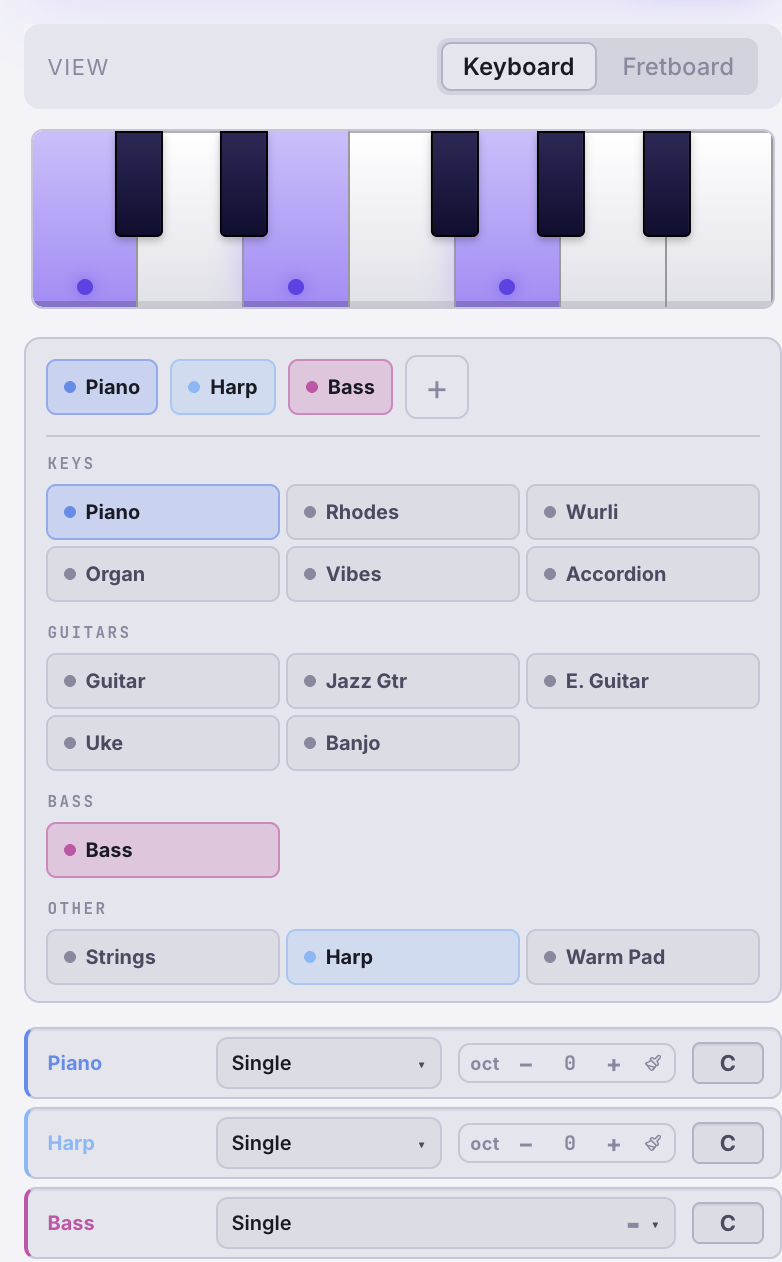
Piano (Salamander) is the default and the most harmonically transparent. It tells you what the chords actually sound like without adding character of its own. Start here when you're still figuring out whether the progression works at all.
Rhodes is the electric piano that made a hundred soul and R&B records feel like they were floating. It adds a slightly dark, vintage warmth. If your chords sound right on Rhodes, they'll sound right almost anywhere.
Wurlitzer sits between the Rhodes and a toy piano - brighter, slightly more brittle, with a reedy attack. Great for indie pop and bedroom recordings. Chords that feel a bit simple on piano often feel perfectly intentional on a Wurli.
Organ fills space more than any other keyboard. It sustains without decay, which means long chord durations feel full instead of thin. Useful when you want to hear whether a progression breathes - if it sounds crowded on organ, the chords are probably too busy.
Vibraphone is the unexpected one. The metallic sustain and gentle tremolo make even dense jazz chords feel open. If you write cinematic or lo-fi music, try a progression on vibes before you try it on anything else.
The string and plucked family
Acoustic Guitar voices chords in the mid-register with natural strum resonance. This is usually the most honest test for a folk or singer-songwriter progression - if it sounds like a real song on acoustic guitar, it is one.
Electric Guitar is clean and compressed, closer to a studio DI. Good for hearing the harmonic detail of each chord without the resonance of the acoustic version getting in the way.
Jazz Guitar has the warm, rounded tone of a hollow-body with a touch of chorus. Minor progressions especially take on a completely different personality here - what sounds wistful on piano sounds smoky and late-night on jazz guitar.
Ukulele compresses everything into a narrow, bright range that forces the important notes to the top. A progression that sounds complicated on piano often sounds instantly singable on uke, which is a useful test: if it doesn't work on uke, it might be harmonically overdressed.
Banjo has the fastest attack of any instrument in the list. The decay is short and the pick is sharp. Useful for country and Americana progressions, but also surprisingly good for clarifying rhythmic ideas - the quick attack makes syncopation obvious in a way that piano sometimes masks.
Harp sweeps through chord voicings with a natural arpeggiation. Because of the way the samples are voiced, it tends to open chord voicings up and highlight the top note as a melody. If you're working out whether a chord melody idea works, harp is the fastest way to check.
Bass
Bass plays the root notes of each chord at the right octave with a clean electric tone. You'd think this would be the simplest instrument in the set - but playing your progression bass-only is one of the most useful things you can do at the arrangement stage. The bass line is the skeleton. If it moves well on its own, the whole arrangement will feel grounded.
Pads and ensembles
Strings turns your chord progression into a string arrangement. Long reverb, gentle attack, rich mid-range sustain. If you're scoring something or testing whether a song can support a cinematic arrangement, strings will tell you immediately whether the harmonic movement is strong enough.
Accordion has a reedy, slightly continental sound with natural tremolo. Folk progressions that feel ordinary on guitar often feel immediately characterful on accordion. Also useful for musette-style writing and anything where you want the harmony to feel slightly displaced.
Warm Pad is the most abstract instrument in the set - synthesized, reverberant, with a long attack and slow release. It strips out all the transient information and leaves only the harmony. This makes it ideal for checking whether a progression has emotional momentum without the help of rhythm or articulation. If it moves you on pad, it'll move people on anything.
Stacking instruments per chord
Here's the feature that most people don't find immediately: in the Chord Maker → Try it, you can assign a different instrument to each individual chord in a progression. The I chord on piano, the IV on Rhodes, the V on guitar. The bake engine mixes them in real time.
The moment you hear a chord change instruments mid-progression, the arrangement starts to feel like music rather than theory homework.
This is how you start sketching orchestration before you have a full arrangement. The verse might be all piano; the pre-chorus introduces strings on the IV; the chorus brings in the full mix. All of that can exist inside a single LandChords session before you've touched a DAW.
Hearing the same song differently
The most practical use of the instrument selection is also the simplest: when you're stuck on whether a progression is working, change the instrument. A chord sequence that sounds clichéd on piano often sounds completely fresh on vibraphone. A progression that sounds too dense on organ might sit perfectly on acoustic guitar.
Your ear gets used to what it hears in a loop. Changing the timbre resets your perception and lets you hear the harmony again rather than the memory of the harmony.
Start with piano to find the chords. Move to Rhodes when you want to hear whether they have soul. Try acoustic guitar to check if they feel like a real song. Put on strings at the end to see if there's a bigger version of this song waiting to exist.
The progression is the same. The song keeps changing. That's the point.